Copy Image
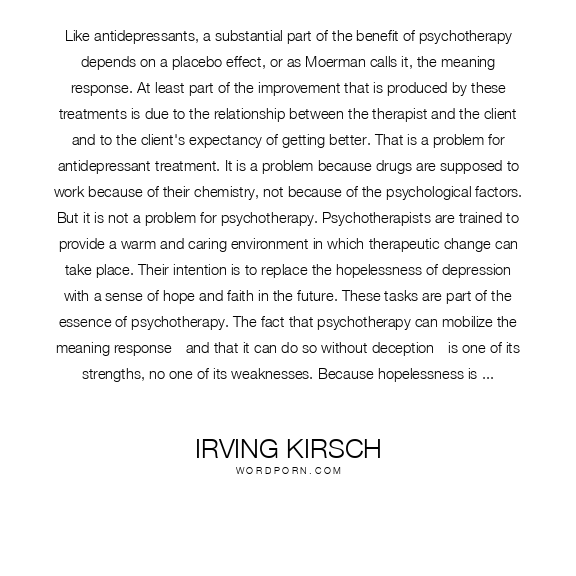
Like antidepressants, a substantial part of the benefit of psychotherapy depends on a placebo effect, or as Moerman calls it, the meaning response. At least part of the improvement that is produced by these treatments is due to the relationship between the therapist and the client and to the client's expectancy of getting better. That is a problem for antidepressant treatment. It is a problem because drugs are supposed to work because of their chemistry, not because of the psychological factors. But it is not a problem for psychotherapy. Psychotherapists are trained to provide a warm and caring environment in which therapeutic change can take place. Their intention is to replace the hopelessness of depression with a sense of hope and faith in the future. These tasks are part of the essence of psychotherapy. The fact that psychotherapy can mobilize the meaning response - and that it can do so without deception - is one of its strengths, no one of its weaknesses. Because hopelessness is a fundamental characteristic of depression, instilling hope is a specific treatment for it it. Invoking the meaning response is essential for the effective treatment of depression, and the best treatments are those that can do this most effectively and that can do without deception
Irving Kirsch
-
-
Copy Image
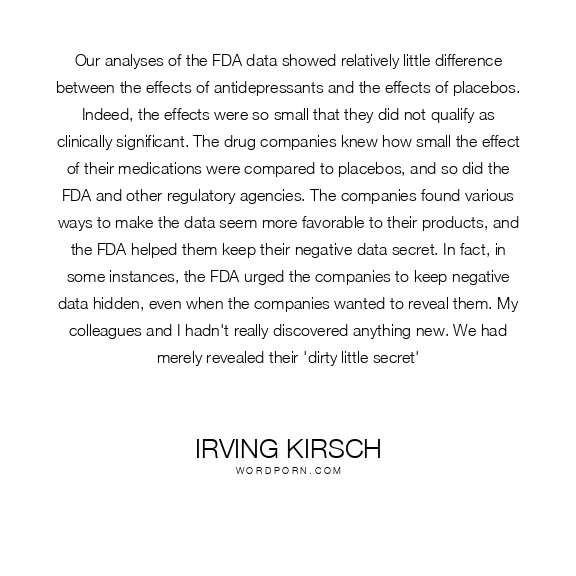
Our analyses of the FDA data showed relatively little difference between the effects of antidepressants and the effects of placebos. Indeed, the effects were so small that they did not qualify as clinically significant. The drug companies knew how small the effect of their medications were compared to placebos, and so did the FDA and other regulatory agencies. The companies found various ways to make the data seem more favorable to their products, and the FDA helped them keep their negative data secret. In fact, in some instances, the FDA urged the companies to keep negative data hidden, even when the companies wanted to reveal them. My colleagues and I hadn't really discovered anything new. We had merely revealed their 'dirty little secret'
-
Copy Image
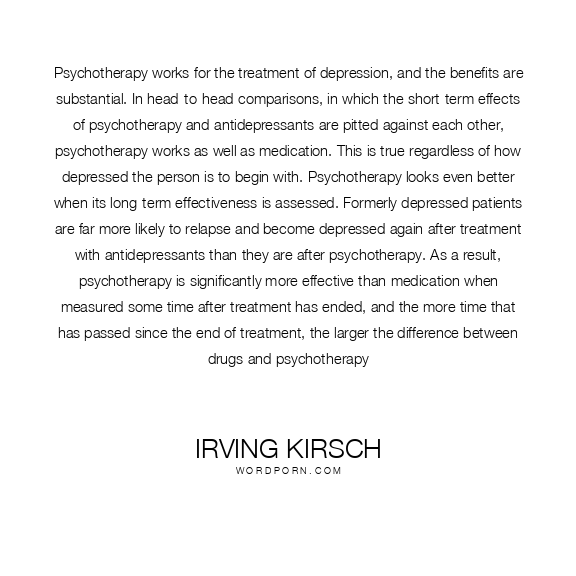
Psychotherapy works for the treatment of depression, and the benefits are substantial. In head-to-head comparisons, in which the short-term effects of psychotherapy and antidepressants are pitted against each other, psychotherapy works as well as medication. This is true regardless of how depressed the person is to begin with. Psychotherapy looks even better when its long-term effectiveness is assessed. Formerly depressed patients are far more likely to relapse and become depressed again after treatment with antidepressants than they are after psychotherapy. As a result, psychotherapy is significantly more effective than medication when measured some time after treatment has ended, and the more time that has passed since the end of treatment, the larger the difference between drugs and psychotherapy